The Adventures of John Martin

Updated: Aug 16
John Martin may not be a widely recognized name outside of Pickens County, Georgia. But to locals, he's as Americana as Waffle House, baseball, and barbeque. To most Pickens Countians, John is instantly recognizable in his customary garb: a tan cowboy hat, blue liberty brand overalls, button up shirt, and eyeglasses. And if you're eating at a local mom and pop establishment, and you don't see John, take a listen. His distinct southern dialect, baritone voice, and guffaw will give him right away.
John was born on February 1, 1942, in Atlanta. In his youth he looked every bit the athletic sort and his dark hair and features favored those of his father, the esteemed journalist, Harold Martin. Harold worked for the Saturday Evening Post and for the Atlanta Journal and Constitution. For long swaths of time, Harold would leave the family on worldwide assignments for the Saturday Evening Post. While the family resided in Atlanta, he and Mrs. Martin would take John to church at the Cathedral of St. Phillip.

As John's parents attended the sermon, he and his friend "Buddy" Ware Hutcheson would sneak off from Sunday School and play with toy cars. Their early church adventures would form a lifelong friendship between them lasting well into their eighties.
In 1947, John's father purchased the King Cottage at Tate Mountain Estates. It served as a secluded place to write his three required weekly articles for the AJC. Prior to the Martins arrival at Tate, the cottage was occupied by the caretaker of Tate Mountain Estates Golf Course.
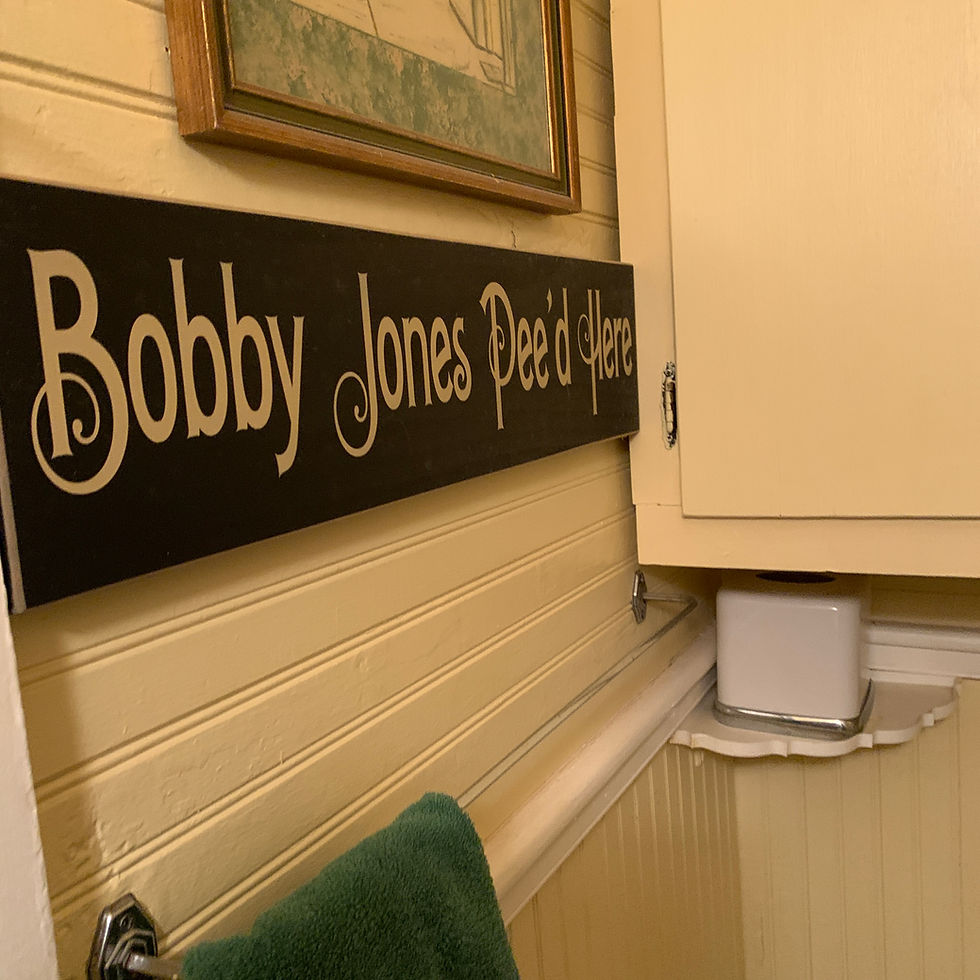
One of the first visitors in the early days of the cottage was the famous golfer Bobby Jones. Before the Martins moved in, Bobby Jones had stopped over to use the restroom. To this day, a large wooden sign commemorating the visit hangs in the bathroom.


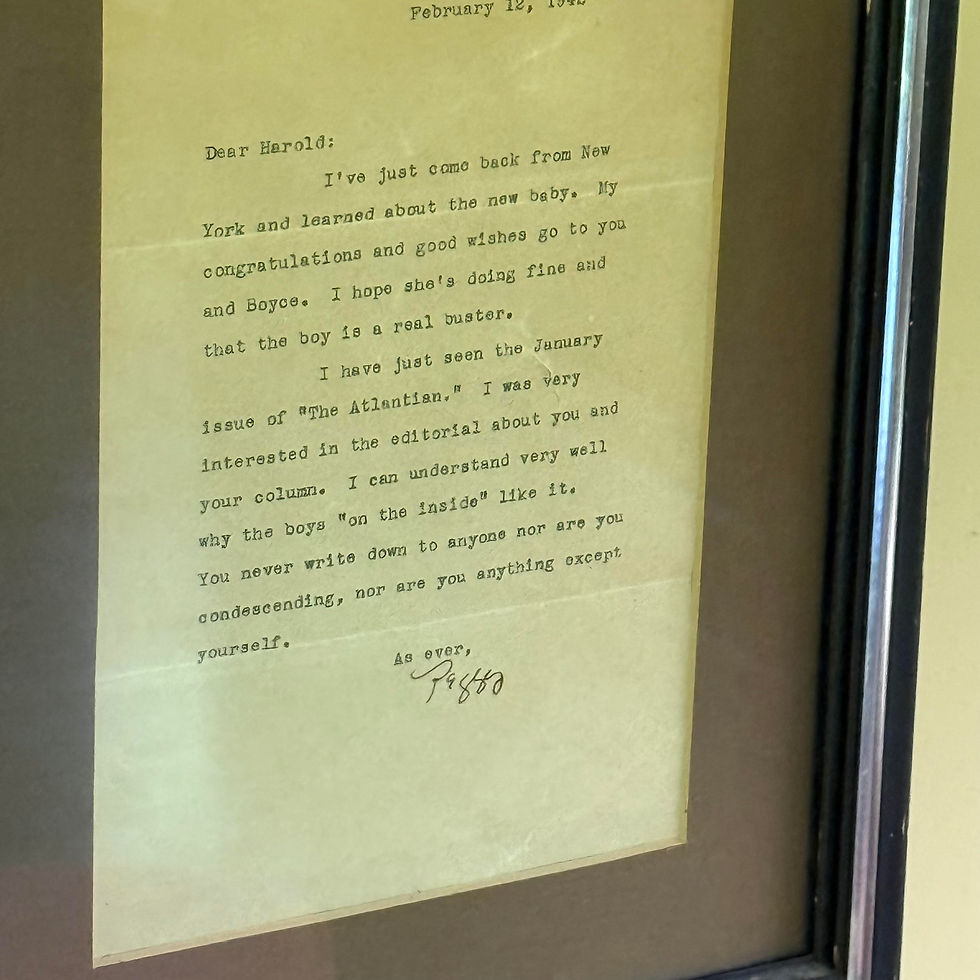
Bobby wasn't the only celebrity to have spent time with Harold. Margaret Mitchell, the famed author of Gone With The Wind, was close to Harold and penned the Martins a letter shortly after of John's Birth.
________________________________________
In the 40's, the roads up to the mountain weren't paved beyond the railroad tracks in Jasper headed toward Burnt Mountain and beyond. One day, little John asked his dad if people were racing down the dirt roads. His father told him that revenue agents were chasin' bootleggers on their way to Atlanta.
From the age of five, John would spend his summers in Tate Mountain Estates, and his school years in Buckhead. Between the two spots, John preferred exploring the mountains, forests, and creeks of North Georgia more than the bland texts of his classes.
While at Tate Mountain Estates, he spent lots of time with the community caretaker, Olin Cantrell. One day while traveling around Tate Mountain Estates with Olin, Mr. Cantrell pointed out the location of the skull of Peter Cantrell, an ancestor of Olin who was murdered by the Jordan Gang during the Civil War. Olin dug up Peter Cantrell’s skull near the Tate Gymnasium on a ridge line above the gravesite.

NOTE: The Jordan Gang, like McCollum's Scouts, were groups of marauding former soldiers who preyed on vulnerable widows during the Civil War. These bandits are euphemistically known as "Home Guards."
_______________________________
John has an early memory of his maternal grandparents and their House Servant Will Mills. Will was dropped off by his parents at John's grandfather's house. He was just 15 years old. The Mills told John's grandfather, Dr. Hugh Montgomery Lokey, if he would provide room and board for their son, Will would be a loyal worker. The Lokey's accepted. By the time John was a young man, he fondly recalled hanging out with Mr. Mills in his grandparents' kitchen with the other visiting grandkids. "Now you boys look out for them womens.", Will said. All the boys laughed.

Will lived the rest of his days in the care and protection of the Lokeys. He was born in 1909 and lived with the Lokey family since 1924 until he passed away in 1980 at the age of 71.
__________________________________
John's paternal grandparents lived in Commerce, Georgia on a family farm. One day a relative of John's walked off to use an outhouse. On the way, he heard a muffled scream from a nearby well. The family ran over to see the source of the commotion, and a friend of John's family was in a great deal of pain from a botched suicide attempt. His arms were trapped in a rope knot with his whole body suspended uncomfortably. The man was subsequently hospitalized at the sanitarium in Milledgeville.
Several months later at a family gathering, the former inmate of the sanitarium ambled down the road.
"They let you out already?"
"No, I escaped."
"Why'd ya do that? And you walked all the way here?"
"Well, they were crazy. I was sitting down on a bench when another patient sat down beside me."
"And?"
"And when he started trying to feed pea soup to a part of his body your not intended to, I ran! Those folks are crazier than me!"
John's relative was cured.
______________________________________

John went on to graduate from Northside High School in 1960 and after a failed attempt at successfully completing his undergraduate studies at the University of Georgia, John decided to try his fortunes elsewhere.

In 1962, John and his friend Buddy Hutcheson made their way to Montana, where they briefly worked together at Glacier National Park. Two weeks later, they traveled to find work at a cannery in Pendleton, Oregon. Unfortunately, their two-week detour cost them to miss the opportunity. They finally made it to the cannery, but the jobs were gone. So they tried their hands at manually working in local pea fields. While harvesting peas, John noticed the pea delivery drivers sitting around reading comics inside their delivery trucks and asked them how to get hired as a pea delivery driver. After learning the specifics, John and Buddy traveled to Athena, Oregon, to meet a man named Dutch. He hired them as truck drivers to canneries in Walla Walla, Washington.

Eventually, Buddy and John grew tired of day laboring in Oregon. They made their way down the Pacific coast to Los Angeles, before heading east to Las Vegas in an attempt to double their earnings. They traveled east and the terrain turned barren and hot. They accidentally chose the route through Death Valley. Soon, the two young men, more practical than shy, drove through the desert sans clothes in John's '56 Chevy Convertible. They made their way to Las Vegas and lost their summer earnings. They had no choice but to make the long trip home.
________________________________

John was struggling in college and in the summer of 1965, decided to make his way back to Oregon in a second attempt at cannery work. The mid-sixties were a volatile period of American race relations. Rather than driving through Alabama and Mississippi on his way to Oregon, he took a bus from Atlanta to Dallas. When John arrived in Dallas, he sat down on a slight grass covered hill when he was suddenly overcome by a strong sense of deja vu. John looked up and saw the Texas Book Depository. He was sitting on the grassy knoll in Dealey Plaza where President Kennedy had been assassinated a year and a half before!
___________________________
John finally made it back to Oregon but he was too early for the pea harvest. John registered with the Oregon Department of Labor and waited in lines looking for employment. Mrs. Meredith Doble, an elderly widow who needed help around the yard, came and selected John from the line. She provided John a meal each day as long he ate outside. Mrs. Doble paid John five dollars a day and their arrangement lasted several months before John decided to return home. John's mother had warned him since he dropped out of college his draft deferment for attending college had ended. John had to enlist. John called his good friend Buddy and as fortune would have it, Buddy was traveling to Wahpeton, North Dakota to pick up a car for his dad. If John could find his way to North Dakota, he could catch a ride with Buddy home.
John hitched a ride with a group of native americans. One of the men, speaking in a incomprehensible language, whispered a series of sounds. When John asked what he meant, the Indian answered, "You shall be known as Young Roaring Bull from Georgia." The other men pressed John for his real name, and he replied John Martin. The group, perhaps distrustful of white men, demanded John show them his identification. John refused and was immediately thrown out of the vehicle. John fell asleep on the side of the road. When he arose the next day, John found himself in a ditch on the side of Highway 90. The irony of the sign wasn't lost on him.

John arrived home on the fourth of July, 1966. He waited three days and enlisted in the United States Army. Soon he was deployed to Vietnam. While John was in country, his father Harold was asked by the Saturday Evening Post to write a story on soldiers in Vietnam. Harold chose his son as his subject and flew out to meet him. For a time, Harold shadowed John and even practiced firing weapons. In a bizarre training accident, Harold misfired a grenade launcher and got shrapnel lodged in his back.


Harold Martin flew home after his writing assignment ended and John returned to his regular duty. In February, 1966 John got shot near his left knee. Later in August John was aboard a helicopter taking heavy gunfire. There was no discernable landing zone, so the chopper napalmed an area to create a landing pad. Under intense fire, the pilot decided the soldiers should jump to the surface or return to base. The men jumped out onto the recently exfoliated landing zone.
To his dismay, John jumped out of the helicopter at a height of fifteen feet while wearing seventy pounds of gear. John's knee shattered upon impact. All the other men jumped landed without injury, but John was forced to relinquish his rifle to the other men and ordered to stay behind and wait for their return. Because of his injury, John was the only man from the chopper who lived. All the other men who traveled with John died that day in a firefight. John refers to his right knee as his lucky one. The Army returned for John and he was flown out of country to a military hospital in Japan. John was surprised to meet his father's wartime friend named George Misoto. George was one of the men who translated and first communicated the surrender of the Japanese on the Battleship Missouri.

After returning stateside in 1967, John met a pretty young lady named Susan Davenport. When they first met, she wanted nothing to do with him. She was urbane, sophisticated, and John seemed a bit too backwoods. Yet, in a short while, she and John found themselves on a first date at the Fox Theatre in Atlanta featuring Gladys Knight and the Pips. In short order, Cupid's arrows had struck, and the two lovebirds tied the knot in the spring of 1967 at Ft. Sill, Oklahoma.

John was stationed at Fort Sill when Susan found herself pregnant with twin girls, Laurie and Becky. They were the first of the Martins' three children. Four years later, John's only son, Farrell, was born.

After being discharged from the Army, John decided to give college a try for the second time and began his undergraduate studies at Georgia State University. He graduated with a degree in Business in 1973 and began a long career of office furniture sales.
Over the next two decades John and Susan raised their three children and slowly began expanding the Martin Cottage in Tate Mountain Estates to accommodate their larger family.

In 1999, after their children were grown, the Martins permanently relocated to Tate Mountain Estates where John could keep up with his hobbies like storytelling, attending history speeches, or polishing and driving his Model-As.
Sadly, in 2020, John lost his wife to cancer after many wonderful decades. The night before she died, John played Elvis for Susan, knowing it would bring her comfort. She always told him she was going to find Elvis when she made it to Heaven. But John has a plan. When he joins her in the afterlife, he's going to go find the soul of Miss Kitty from the TV series Gunsmoke to distract Elvis long enough for John to get Susan back.

__________________________________________________________
I met John shortly after Susan passed away at an event at a local funeral home. I was hired to play background music at Christmas-themed celebration of life when a Santa-esque man in overalls approached me with a one-of-a-kind southern drawl. If you know John, there's a mirth and musicality to the timbre of his voice. I suspect all people who meet John are disarmed by his comforting presence and become instant friends.
These days John can be found delivering Meals on Wheels to needy families around Pickens County in his Nissan truck, attending a Tater Patch Players performance in Jasper, or frequenting his favorite breakfast joint, Annie's. And if you ever sit down with him at Annie's be sure to look at his plate. You'll find a S.O.B. - Sausage (but it's really hamburger meat) Over Biscuit with white gravy beside a cup of Joe. He also will sneak out his special salt from the top of his overalls.
John speaks lovingly of his late wife, his three children, and ten grandchildren. They visit him often. Recently his granddaughter Ali became a member of Tate Mountain Estates as did his grandson Jack. Four generations of Martins are Taters!
NOTE: A Tater is what the folks of Tate Mountain Estates refer to themselves as.

________________________________________
What follows is an example of the type of story only John Martin could tell. I heard this one at Annie's.
In the 70's, while spending time at Tate Mountain Estates, John and his friend Bill Bryan decided to drive along (the now abandoned section) Old Burnt Mountain Road while shooting road signs with a pair of six-shooters. They traveled to (the now vacant) Johnson's Grocery on Highway 52. But Johnson's Grocery had a secret. It really wasn't a grocery store at all, apart from a dozen eggs it kept in stock. Johnson's grocery was actually known by John and Bill as the Dirty Shame Saloon.


When John and his friend made it to the Dirty Shame Saloon, the owner kicked all the drunken patrons out except for John and Bill so they could fire their six-shooters out back. The only problem was the exiled patrons decided to exact revenge on John by flattening all four of Bill's tires.
Mr. Johnson felt it necessary to grab his shotgun for protection as he drove them home. Upon learning what happened, Susan and Bill’s wife Lillian intervened. That was the last time John or Bill were allowed to go to the Dirty Shame Saloon. Another adventure was over, many followed, and more are yet to come. Long live John Martin!


Comments