The Village of Alice (Revisited)
The Amazing Legacy of Harmony Mills and the ruins of Alice

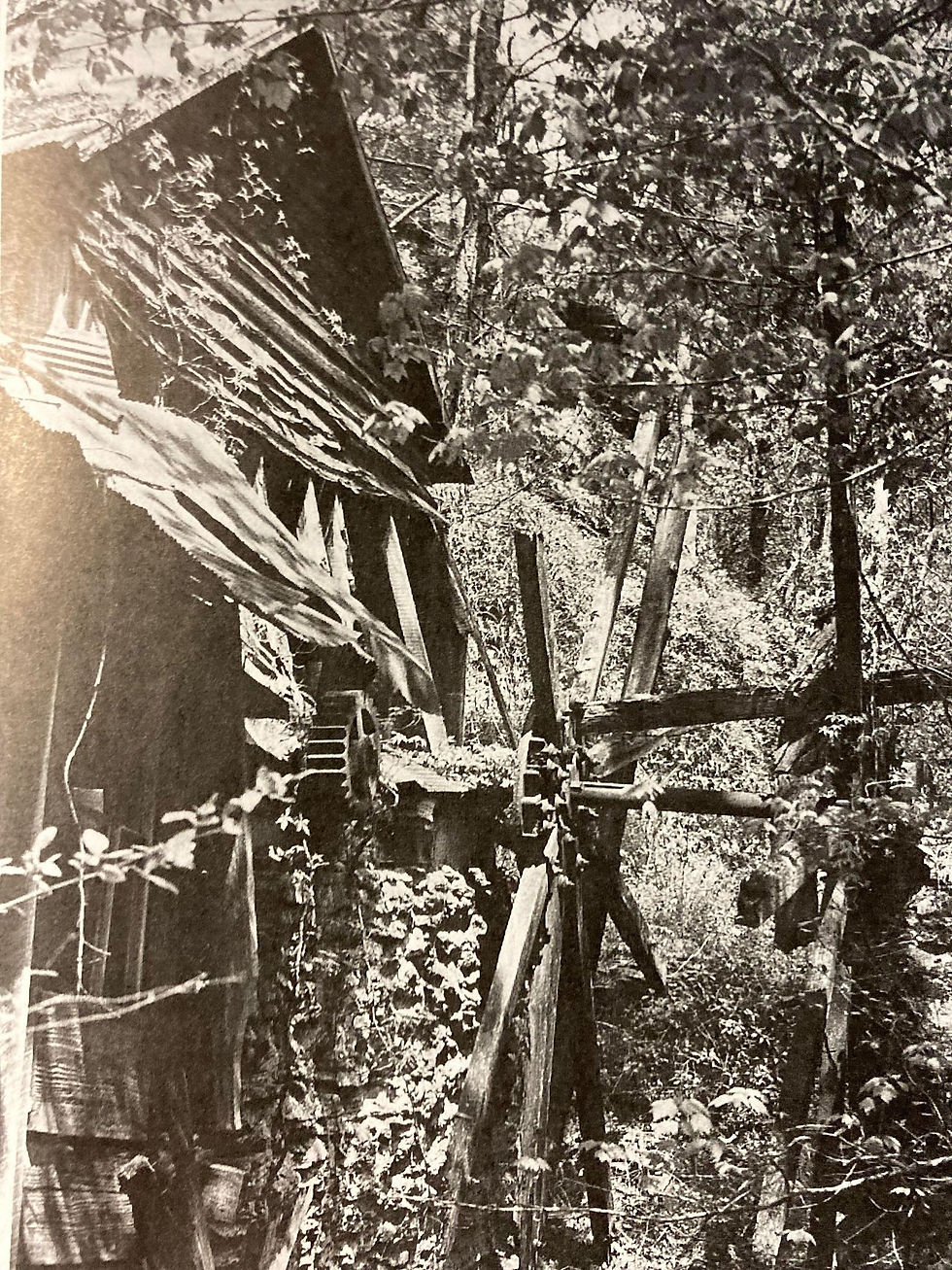
The Harmony Mills at Alice, was the most spectacular accomplishment of the Atherton brothers. Built in 1882, this combination grist and textile mill had 800 spindles and was funded with capital of $25,000. Water flowed through a system of ditches around a mountain for more than one mile and a half to provide a drop. A wooden race stood fifty feet in the air and was approximately five hundred feet long. The iron spikes, a part of the wooden mill race, remains visible on the hill near the waterfall closest to the house on Town Creek.

At the beginning of the ditch, near modern highway 515, a small dam once channeled
water into the race. Any trace of this dam is now under a modern flood control dam. Much of the ditch remains visible. Sadly, the Harmony Mills, damaged by a flood, finally burned around
1901.
Who Was Alice Named For?
The small village of Alice was named after Tom Atherton’s wife. Apart from the two mills,
n the heyday of Alice’s burgeoning village, there was a blacksmith shop, post office (located at Harmony Mills), school, store, and several homes connected by a series of dirt roads near the mill and on the hills above it.

The Atherton brothers: Tom, James, and William, originally came from Manchester, England.
The English had mastered the textile industry long before their American counterparts, and the Atherton’s brought their manufacturing talents and became prominent citizens of North Georgia, particularly Jasper. They lived in New Jersey, South Carolina, and Alabama, before making their way to Georgia. Their manufacturing prowess resulted in the development of the Rope Mill in Woodstock and the Talking Rock Mills (largely destroyed during the Civil War), before building Harmony Mills at Alice. The Atherton property was one of the few places in Pickens County where gold was found. However, the mines were exhausted prior to their purchase in the 1880s.

William Atherton’s house was one of several houses on the property. Atherton and his
family in Alice. Note: the chimney was made from more expensive bricks than many of the
local houses, and the windows and doorway were more ornate than traditional North
Georgia homes.


Where was Alice?
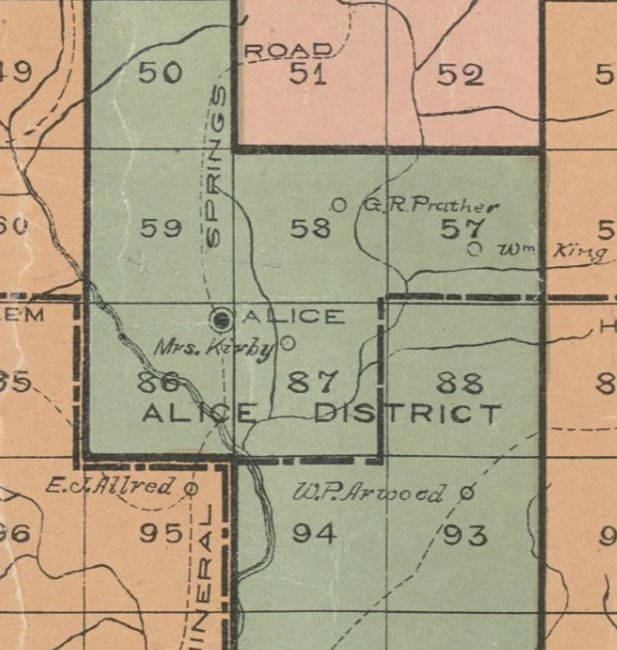
The two-room schoolhouse was located directly north of the Atherton property. Land Lots 58, 87, and 88 form the connected lands of the Atherton family in the shape of an L on Henley’s 1903 Pickens Map. A former resident of the area recalled their having been a well inside one of the two rooms.
The Atherton family as seen on the 1880-1887 Tax Digests. Note: They had fifteen workers
on their land. Most of the workers made cotton, others were machinists or store clerks.
Who was Alice?
Alice was born in New Hampshire as Alice Nutter on Aug 2nd, 1829. She met Thomas Atherton when he lived in New Hampshire. A lice was eighteen years old in 1847 when she and Thomas married. By 1850, Alice, Thomas and their two-year old son James, were living in South Carolina.
By 1860, she and Thomas had moved to Alabama. And by 1870, she and Thomas were living in North Georgia. In her later years, Alice was colloquially referred to as “Aunt Alice” and was
known to be a woman of virtue, kindness, and dignity. She was resigned to staying in a chair
due to poor health for her last eighteen years, but Alice was not one to complain.
She and Thomas were married forty-four years before she died on August 22nd, 1891, nine years before the destruction of Harmony Mills, at the age of sixty-two. She is buried in the Jasper City Cemetery beside her husband Thomas, who died 6 years later. Thomas was listed on his census as a Man of Cotton Yarns - and out of love for his wife, named the village after her.
Why Is Alice Special?
The current property sits on Land Lots 50, 59, 58, 86, and 87. Half of the land
belonged to the Atherton family. The grist mill, and mill race ruins are unique in the
Southeastern United States and serve as an example of 19th Century ingenuity. Furthermore, the legacy of the Atherton family throughout the Southeastern United States should be protected. Ruins, however old, serve as a tangible reminder of the past, our ancestors, and their ingenuity.
Investigation and Discovery
In the fall of 2025, I led groups of my middle and high school students to the former village. For this special occasion I brought a metal detector. At the site, the students asked where I thought the best place to search for artifacts might be located. I told them on a slight rise, maybe fifteen feet from the grist mill ruins. Within a few moments, I heard a kid yell out “I found something Mr. Feldt!”
Shortly thereafter several items were uncovered. The most notable among them, a part of a plow and a handcrafted muleshoe. At the site, I pulled up a picture of Alice’s former blacksmith, R.J. Cox and showed the kids the likely source of the muleshoe they found. They were beyond excited. History had come alive for them in a way it never had before. R.J. Cox operated a sawmill and blacksmith shop on his section of Alice.

Later, I identified the plow part as an Oliver No. 10 – a chilled moldboard plow
part marked with the sequence F2742. It was made by the Oliver Chilled Plow Works of
South Bend, Indiana, after 1901 and before 1929. Its creation fell within the years the village was in operation.


The Oliver Chilled Plow Works had an annual production capacity of over 500,000 plows
per year and at least one of them found their way to Alice.
In June of 2026, I moved onto the property as the caretaker of Alice. There was a lot of property to explore. Across Town Creek and not far up the roadbed near the former bridge which spanned the creek is the ruins of an old homestead. There is a fifteen foot long stacked rock wall that is about two feet high. Near the wall is evidence of a root cellar. Not far from the ruins are the remains of an old log bridge which went across a spring fed ditch.
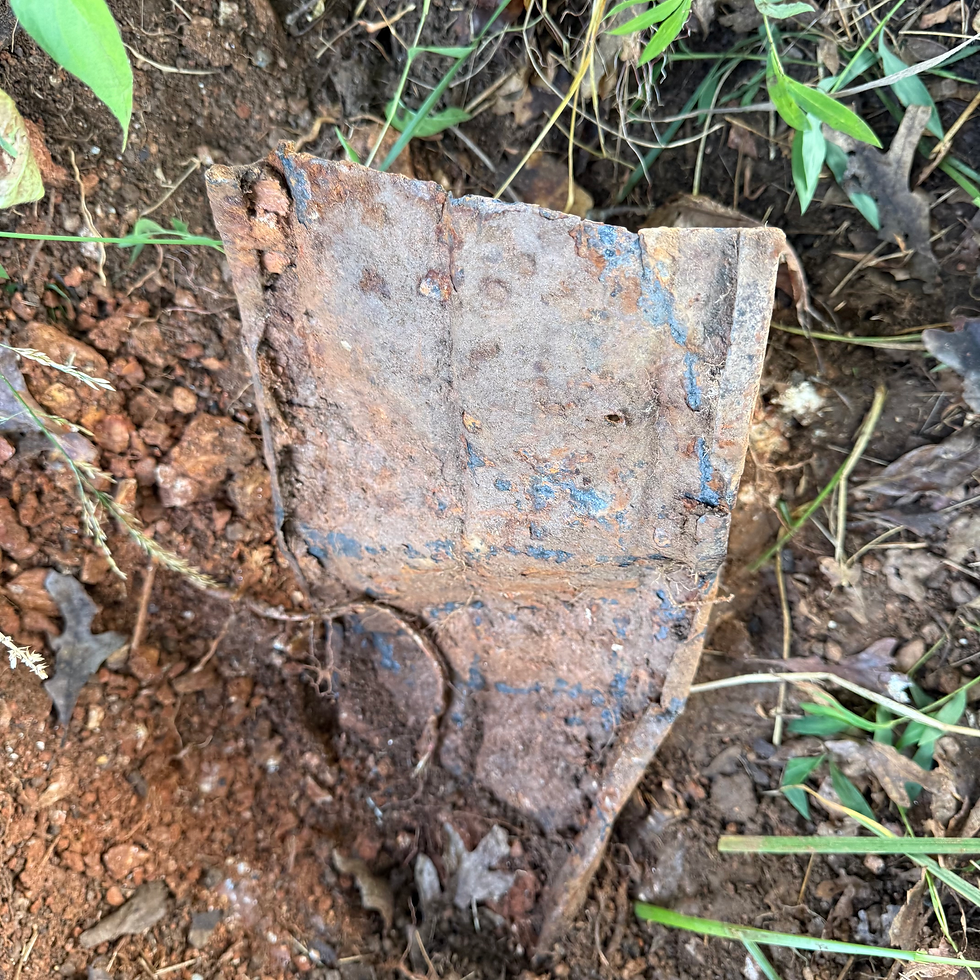
At the site of the old schoolhouse my metal detector pinged hard. And after digging a little, a piece of the old schoolhouse room was found.
Across Salem Church Road (formerly named Mineral Springs Road South around the turn of the 20th Century) there are several interesting man-made features. One is a stacked rock wall, perhaps over 20 feet long and nearly 2.5 feet high.

The wall demarcates a small rise in elevation which is perpendicular with the top of the wall. At the north side of the wall there is something that resembles a chimney fall (the collapsed rocks of an old fieldstone chimney.) A second similar wall is located less than a 1/4 mile from the first wall beside a fork in the middle of two roadbeds.
Perhaps most interesting is the gravestone located near the northern boundary line just east of Pettit Creek. In the middle of a flat, clear area, stands a vertical rock about a foot high, 15 inches long and two inches thick. There are no depressions nearby to indicate the rock was forced up by the falling of a tree and raised rootball.

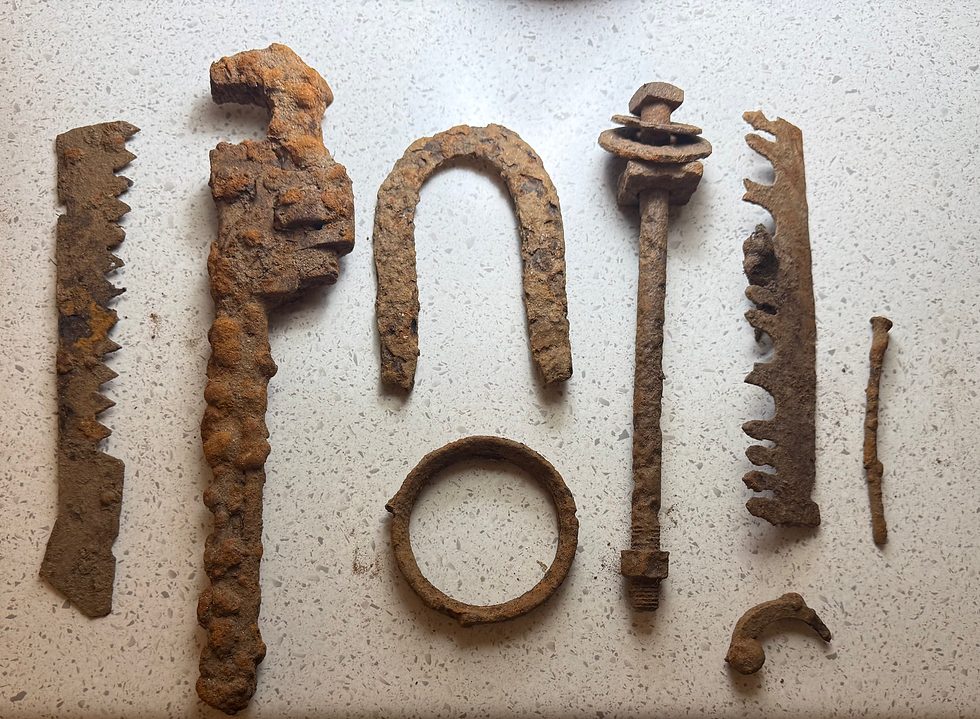
This September, my middle and high school students returned to the site to take another shot at artifact recovery. They literally hit pay dirt. Among the items found were another mule shoe, a couple of saw blades, a gasket, an iron staple, a giant pipe wrench, an iron wagon wheel band, and a bolt that likely was part of the grist mill.
The Final Mystery
Alice has one more mystery. Somewhere on the property, in May 1864, Reverend Isaac Padgett climbed the mountain at Alice and placed a rock in the fork of a hickory tree as he was listening to the guns at the Battle of Resaca. 25 years later, people living at Harmony Mills (Alice) climbed the same mountain and found the same hickory tree, only to find the rock where it had lain for all those years.

That old hickory still might be atop one of these mountains, waiting to be found once again.


Comments