The Lewis Furnace
The Lewis Furnace was built in 1847. It was built by Jacob Stroup in Bartow County and named for the industrialist, physician, and state legislator John W. Lewis. In 1847, Dr. Lewis, Mark Cooper, and others incorporated the Etowah Railroad Company. Governor Joseph E. Brown later appointed Dr. Lewis superintendent of the Western & Atlantic Railroad, a position he held for three years. The railroads were instrumental in moving heavy products through Bartow County to the north.
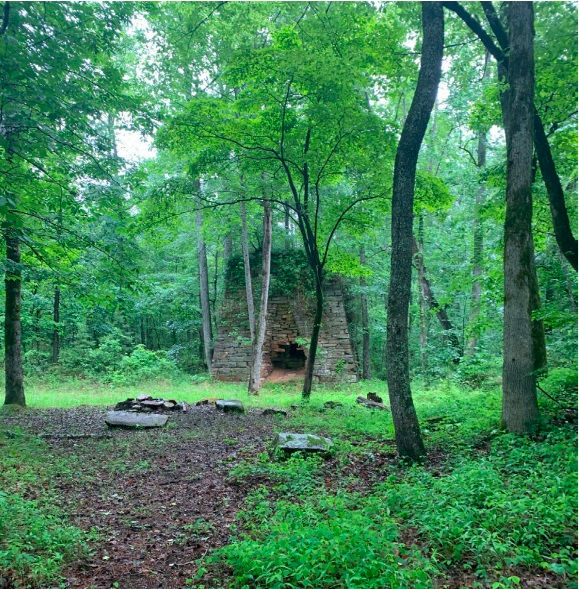
What is an iron foundry?
Iron foundries, especially in the Antebellum era, were large industrial operations capable of producing different types of iron. Most of the foundries in Georgia were built in Bartow and Cherokee Counties – primarily because of the mineral constitution of the land. Bartow and Cherokee County both possessed large quantities of iron ore and manganese. Both were used to make iron.
All the foundries of the early to mid-19th century were built of giant stone blocks. They were typically between 30 and 35 feet high, were trapezoidal in shape, and had long shafts, lined with fire like a chimney lined with a temperature resistant covering that extended from the top of the foundry to the conical area of the furnace known as the bosh.

The iron would be dropped into the top of the foundry between layers of coal or coke, usually over a small wooden bridge that extended from a nearby hill or rocky face.
All foundries were located next to creeks, rivers, or fast-moving streams. Water power was necessary to power the waterwheels which in turn would power a giant bellows (a device which is used to increase the volume of air) which would go through an inlet pipe to increase the temperature of the fire beneath the shaft to liquify the iron.
Once the temperatures were sufficient, plugs were released and the liquid metal would be poured into long troughs that were dug into the soil. This is why this type of iron is called “pig iron”.
There were over a dozen iron foundries built in the mid early to mid-1800s in North Georgia. Most of them were built in Bartow and Cherokee County. Most of them were built by the ironmaking Stroup family.
The John Lewis furnace is largely intact in 2026. Another name associated with the furnace is Jacob Stroup. The Stroup family immigrated from Germany to the United States in the early 1700s in Maryland. Mathias Stroup learned about iron manufacturing in Germany. He, his son Jacob, and grandson Adam, built various iron foundries in the states of Pennsylvania, and South Carolina. Adam and Jacob Stroup sided with the colonists in the American Revolution and were masters of iron components for guns as well as bayonets.

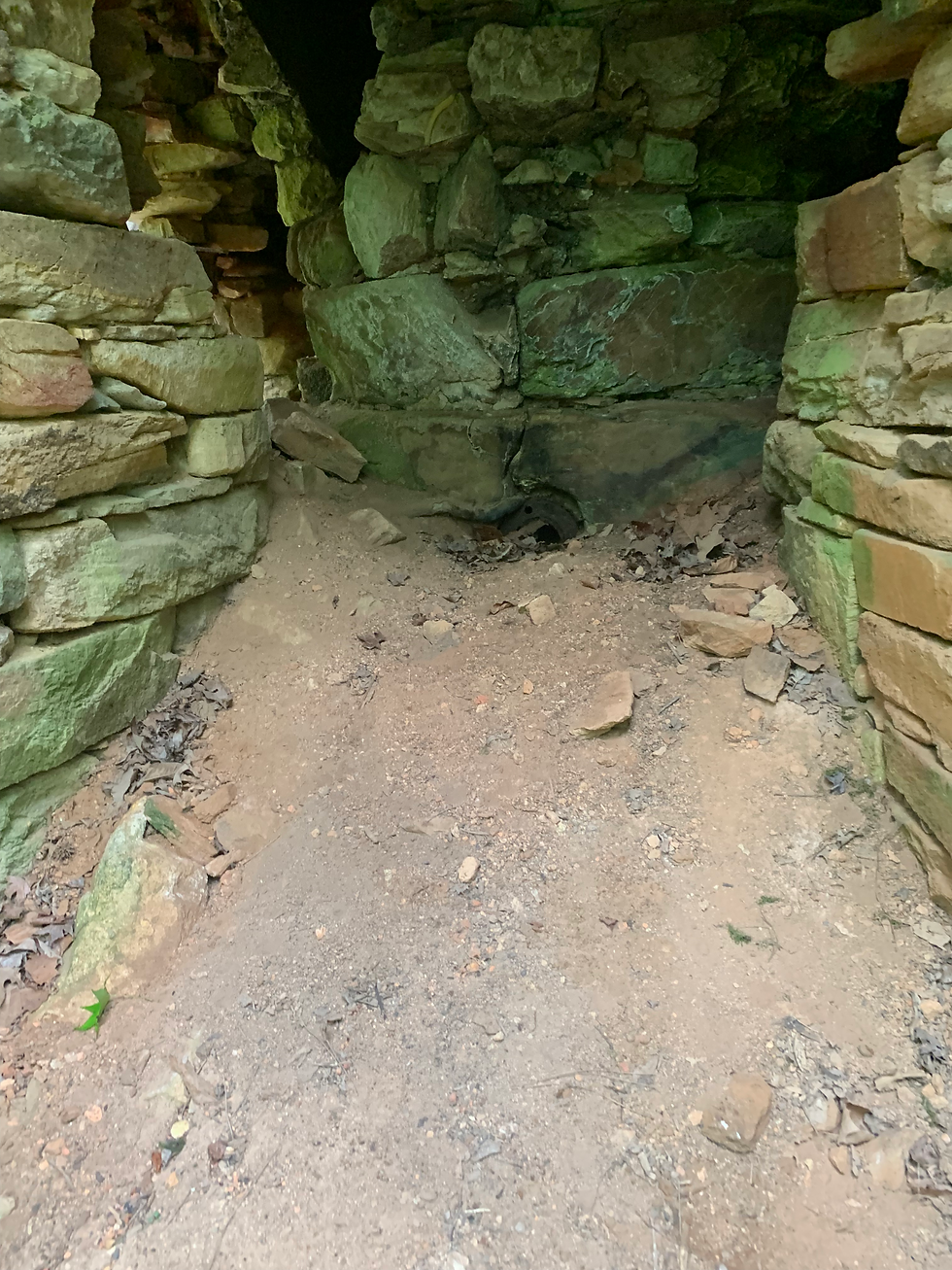
The waterwheel and bellows would have been installed near the rock
formation at the bottom of the above photo. The wheel, powered by the creek,
would have provided the extra heat necessary to make the iron. Stamp
Creek is just out of sight behind where this picture was taken.
To reach this property, today, one must hike 3.4 miles from the nearest gate. When
I visited the site in 2020, it was still leased by the State of Georgia as part of the Pine Log
WMA. The site was controlled by the Apex Hunting Group for the last five years or so.
The State of Georgia just announced a plan to repurchase the land and to prevent
development.
A few years ago, a very long lease between the Neel family and the State of Georgia
expired. The State of Georgia originally would not offer the money asked for by the family.
Plans were hatched to develop the 14,000 plus acre parcel into industrial and
residential sites. Fortunately, as of September 2026, those plans are permanently
off the table.


After the Civil War, most of the financial resources needed to maintain
and operate foundries in the area were depleted. By the 1870s, most of the
iron furnaces were no longer producing anything near their maximum capacity of
the 1850s.
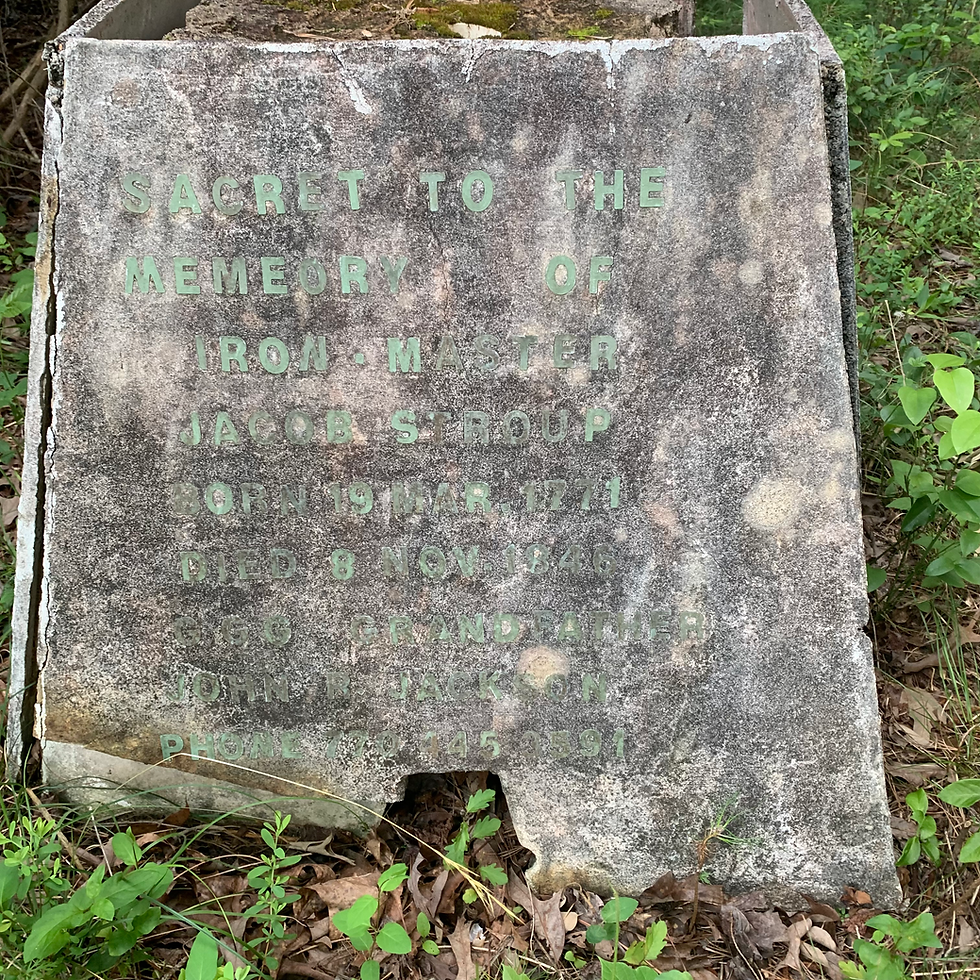
Jacob Stroup died at his home near present Lake Allatoona. The monument beside
his tombstone in Bartow County is in the shape of a foundry and is featured below.
It reads Sacret to the
memeory of iron master
Jacob S. Stroup
Born 19 Mar 1771
Died 8 Nov 1846
G.G. Grandson
John R. Jackson

Moses Stroup moved on to build several furnaces in Alabama, including the famous Tannehill complex shown below.


Comments